Post-Deployment Smart Contract Monitoring: Where DeFi Actually Lost Money in 2026
The smart contract security conversation is dominated by what happens before mainnet. Audit firms, contest platforms, formal verification, testnet campaigns: the pre-deployment stack is mature and well understood. What happens after the report lands in your inbox is not.
This article is about that second half. Post-deployment smart contract security is everything that protects a contract after it goes live: continuous re-checking against vulnerability classes discovered after the audit, detection of attacks while they are in progress, monitoring of the dependencies and invariants a protocol rests on, and an open channel for external researchers to report what they find. Below: what an audit structurally cannot cover, what the 2026 loss data says about where money is actually leaving, and how to evaluate the tools that claim to cover the gap.
What an audit does and does not tell you
An audit reports what was true about a specific commit hash on a specific date. It is a rigorous answer to a narrow question, and the narrowness is the point: a reviewer reads a defined scope at a defined moment and reports what they find.
After that date, three things start to drift.
The threat landscape keeps moving. Protocols get hacked continuously, and every hack exposes a technique that was not in anyone's checklist the week before. That knowledge becomes public immediately. It just rarely reaches your code, because almost nobody goes back and re-checks their own contracts against every fresh exploit.
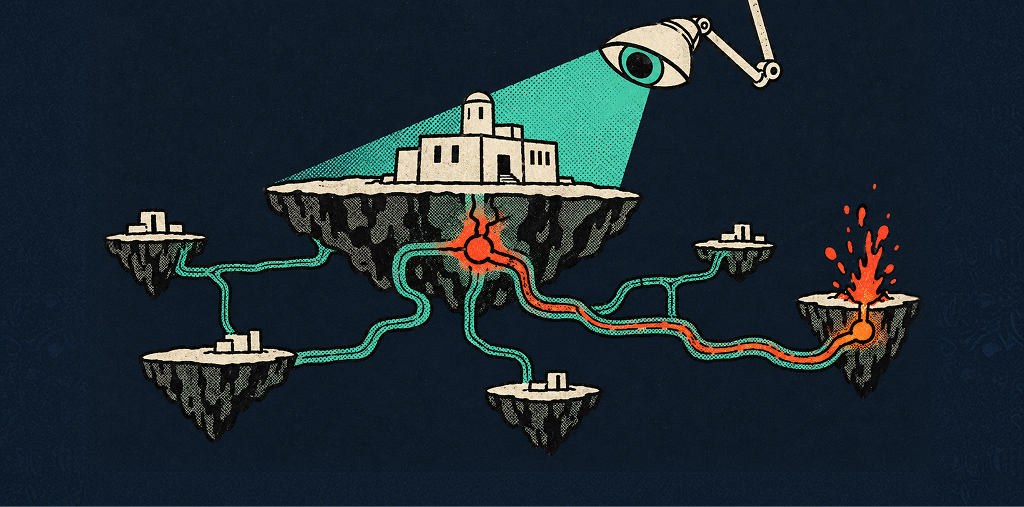
Dependencies ship changes. Oracles, lending markets, AMMs and cross-chain messaging layers develop their own bugs, roll out upgrades and change governance parameters. An upgrade lands in one block and your next call hits the new code. You inherit that risk without touching a line of your own.
Your own code keeps evolving. New modules, new integrations, new chains, governance-triggered parameter changes. The code that was audited is rarely the code actually running six months later.
None of this is a criticism of auditing. It is a description of scope. A report cannot keep watching a dozen protocols yours reads from, and it cannot know about an attack class discovered four months after it was written.
Where the money actually went in 2026
Three datasets are worth putting side by side.
Infrastructure and dependencies. Losses this year have concentrated in the layer around the code rather than inside it. Exploits aimed at external dependencies and third-party infrastructure, including oracles, cross-chain messaging layers, RPC and relayer infrastructure, passed $630 million across the first seven months of 2026.
The year's largest DeFi incident belongs to that category. In April, the rsETH bridge lost $292 million to a forged cross-chain message that a single-verifier setup accepted as valid. Two details matter more than the headline figure. Roughly 47% of applications on the same messaging layer were running an equivalently minimal configuration, so the exposure was shared by hundreds of teams who had written none of the vulnerable logic. And OpenZeppelin's post-mortem makes the structural point directly: reviewing the code of any single component involved would not have surfaced it, because the risk sat in configuration, integration and trust assumptions. Immunefi's six-year loss analysis describes the same concentration effect across shared codebases, shared signers, shared oracle providers and shared infrastructure operators.
Collateral pricing. The second pattern needs no compromised infrastructure at all. TRM Labs counted 32 price-manipulation attacks against DeFi lending protocols in 2026 through August, against 12 in the whole of 2025, which now makes roughly one crypto hack in eight, up from one in seventeen in 2022. On August 30 an attacker inflated a thinly traded governance token by about 100 times in twenty minutes, posted it as collateral, and borrowed an estimated $75 million from a lending protocol on Cronos, after which the chain itself was halted in response. Every contract in that chain of events executed exactly as written. What failed was an assumption about what the collateral was worth.
Copied exploits. The third dataset comes from Hexens, which ran a pipeline that converts each fresh mainnet exploit into a detection query and runs it against deployed code. Over two weeks, twelve live exploit incidents produced 198 confirmed-vulnerable deployments still running on Ethereum and BSC, spanning 80 distinct codebases and nine bug classes. Confirmed there means a reachable path was traced from an entry point to the vulnerable behaviour in the contract's own code, not that the code resembled something. The average vulnerable pattern was live in two or three places at once, and none of those teams knew.
Put together, the three datasets describe the post-deployment problem precisely. You can be exploited by a bug you did not write, in a protocol you did not choose, or by a bug that burned someone else last week and that you never re-checked your own code against.
Why transaction monitoring alone leaves a gap
The dominant model in the monitoring category is transaction and behaviour level: watch on-chain activity, alert when something looks anomalous or when a hack occurs somewhere. Forta, Hypernative, Hexagate, BlockSec Phalcon, Defimon and Glider Monitor all operate in this space, with different emphases. A detailed feature-by-feature comparison of these tools is a separate piece; what follows is about the shape of the problem rather than a ranking.
That layer is necessary and it does the job it is built for. The gap is in the two questions it does not answer.
The first is your own exposure to someone else's exploit. Knowing that a hack occurred is a different product from knowing whether your contract contains the same bug. Answering the second requires reading the exploit, extracting the vulnerability that actually made it work, formalizing it as a query over contract structure, and running it against your code. Signature or keyword matching does not get you there, because the same bug class appears in code that looks nothing alike.
The second is inherited risk. When you build on Aave, Morpho or Curve you do not just inherit their code, you inherit their invariants. An oracle swap, a depeg, a multisig threshold dropping, a timelock reduction: any of these can expose your contracts while your own bytecode stays identical. And it goes deeper than one hop. If your contract sits on a vault that rests on Morpho Blue, a broken invariant at the Morpho level flows straight into your accounting, several layers from anything you chose directly.
How to evaluate a post-deployment layer
Five questions separate exposure management from an alert feed. They work on any vendor, including the ones named above.
- When a new exploit hits another protocol, do you check my code for the same bug, or only tell me the hack happened? This is the single biggest differentiator in the category.
- By what mechanism? Signature matching, heuristics, or analysis of the code itself. Ask them to describe it concretely.
- Do you watch what I depend on, and how many layers deep? Single-layer or snapshot dependency views are common; traversal beyond the first hop is not.
- Can I define my own invariants, and does it require writing code? Invariants are the lowest-false-positive trigger available, which makes them the right hook for automated incident response.
- Do I get told when I am clear, or only when something matches? Silence is not an answer you can act on, and it is not a record you can show a committee.
One timing note for teams re-evaluating right now: OpenZeppelin retired the hosted Defender platform on July 1, 2026, pointing users to its open-source Relayer and Monitor, which you deploy and operate yourself. A number of teams are quietly running without the detection layer they used to have, or running it on infrastructure they now maintain themselves.
What a reasonable stack looks like
Post-deployment security is not a replacement for auditing, and no tool in this category claims otherwise. The layers stack:
- Before mainnet: an audit, and for larger scopes a contest or a second review.
- Ongoing, on your code: continuous re-checking against new attack classes as the industry produces them.
- Ongoing, on everything else: dependency-graph and invariant monitoring, covering the risk you inherit rather than write.
- Ongoing, from outside: a live bug bounty, so researchers who find something have a legitimate and fast path to report it.
The last one is what Remedy exists for, and it is worth saying plainly that the first three matter more than any single tool choice. A protocol with an audit, a monitoring layer and an open bounty is in a fundamentally different position from one holding a PDF from last year.
For the continuous layer specifically, Glider Monitor is the tool built around the exploit-to-detector model described above, running the query engine Hexens auditors use in engagements against contracts you have already deployed, plus dependency-graph and invariant coverage. Onboarding takes a contract address and a chain. The two-week dataset behind the 198 figure is published in full, including the per-class breakdown.
Disclosure: Remedy and Glider Monitor are both built by Hexens.
Sources
- Crypto Economy, July 2026. Cumulative 2026 DeFi losses from attacks on third-party infrastructure and external dependencies. https://crypto-economy.com/defi-loses-630m-to-attacks-targeting-critical-third-party-infrastructure/
- OpenZeppelin, April 2026. Analysis of the rsETH bridge exploit. https://www.openzeppelin.com/news/lessons-from-kelpdao-hack
- Immunefi, 2026. The Ecosystem Vulnerability Scoreboard: 6 Years of DeFi Loss Data. https://immunefi.com/blog/research/the-ecosystem-vulnerability-scoreboard-6-years-of-defi-loss-data/
- Crypto Briefing, September 2026. TRM Labs data on record price-manipulation exploits in DeFi lending. https://cryptobriefing.com/trm-labs-record-price-manipulation-exploits-2026/
- Crypto Economy, September 2026. The Tectonic exploit on Cronos and the 2026 price-manipulation trend. https://crypto-economy.com/kucoin-highlights-rising-defi-crisis-with-32-price-manipulation-attacks/
Frequently Asked Questions
Everything that protects a contract after it goes live: continuous re-checking against new vulnerability classes, detection of attacks in progress, monitoring of dependencies and invariants,
There is no fixed interval that works for everyone, and interval-based thinking is part of the problem. Re-audit on material change to your own code; cover the period between audits with continuous monitoring and a bounty, because neither new attack classes nor dependency upgrades arrive on your audit schedule.
Partially. An integration review can check how you call an external protocol and what assumptions you make about it. What it cannot do is keep watching that protocol's live state, its governance changes, or the protocols it depends on in turn. That part is monitoring, not review.
No, and the two are complements. A bounty brings human researchers who find novel issues nobody has seen yet. Monitoring covers the known set continuously and at machine speed, including the exploit that happened somewhere else an hour ago. Neither substitutes for the other.